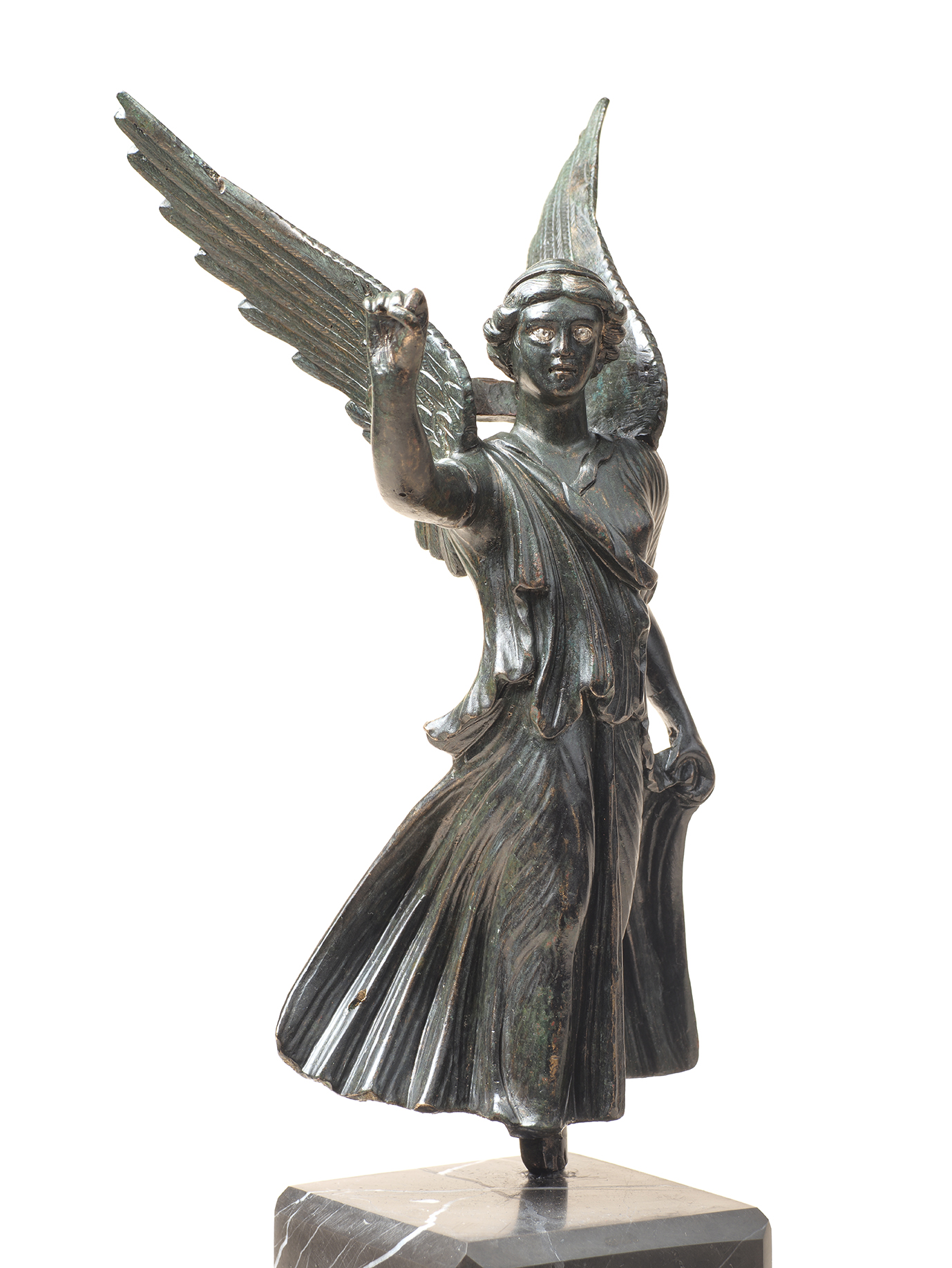
Stone monuments
The dynamics of the Collection of Sculpture and Inscriptions enrichment differs in some periods from the history of the Museum’s departments and has to be traced back to its beginning.
The staff of the Public Library laid the beginnings of an archaeological Collection as early as in 1892, even before the constitution of the Museum as an independent institution.
Number 26 in the first inventory book of the joint institution Public Library with Museum takes a votive tablet, acquired for the Library in 1881. This date is considered to lay the beginnings of the Collection of Sculptures and Inscriptions. The dynamics of its replenishment and the priorities of the institution were always interdependent.
In 1892, when the Museum was already existed as a separate institution, the Collection comprised 343 exhibits and 165 inventory numbers. Alongside archaeological artifacts, objects of ethnographic, paleonthologic, and artistic value were collected. Their description was often so general and so unclear that nowadays it is impossible to identify some of the 14 stone pieces.
The establishment of the Museum as an independent institution urged the systematic enrichment of all Collections. The first private letter in the archives of the Museum is dated 26, 1892. The text illustrates the support of the society given to the Museum to enrich the Collections. The letter is signed by a teacher at the Nikopol Three Grade General School. This man enquired about Latin inscriptions found in the town of Levski. The only purpose of his letter was ‘to discover something interesting about our country.’
The Old Ages (later Antiquity) Department was established to house artifacts from Prehistory to the late medieval period. Vaclav Dobruski was the first keeper and director of the Museum at the same time. Two decades he managed the institution, and the Collection grew significantly to match some other European museums. The first stone artifacts the new Department acquired, were 180 votive tablets from the Asclepion near Zlatna Panega, Lovetch region; more than 120 votive tablets from the sanctuary of the Nymphs near Saladinovo, nowadays Ognianovo, Pazardzhik region; and the collection of Roman statues from Oescus (Gigen), Pleven region. All these artifacts were later arranged in the first permanent exhibition of the Museum. Among the highlights of the exhibition were also the richest Collection in Bulgaria of official inscriptions from Nicopolis ad Istrum, Nikjup, Veliko Turnovo region, and particular exhibits, some of the them of unique value even today (the grave stela of Anaxander from Apollonia Pontica (Sozopol) from the early fifth century BC, one of the eight surviving in the world from that period; a votive tablet from the sanctuary of Heros-Apollo near Lozen (Dinikli), Haskovo region, with a date proving the creation of an iconographic type of Heros in the Thracian territories and the decree for the establishment of a market-place in the province Thrace from Dimitrievo, Chirpan regiopn.
In 1897 the systematic investigation of Preslav and Turnovo started. The artifacts from these excavations initiated the Medieval Collection. The Medeival Department was established in 1908. Petăr Mutafčiev was the first to head the Department until 1920. In this period the collection of marble relief slabs from the royal palace in Preslav and the richest collection of paleo-Christian funerary inscriptions from Sofia, extended to include also items from Varna and Petrich, were collected.
The objects of the Old Ages (later Antiquity) Collection provided grounds also for the first permanent exhibition of the Museum, officially opened to visitors on May, 18, 1905. Votive tablets of Hermes, Zeus, Athena and Heracles from the excavations at Nicopolis ad Istrum, Nikjup, Veliko Turnovo region; many male and female statues; architectural members etc. were included in this exhibition.
In 1910 Bogdan Filov was appointed director of the Museum and head of the Old Ages (Antiquity) Department. His appointment marked a new stage in the Museum’s development. The first total inventarization of the Collections started. For a first time in Bulgaria every object in the Collection was supplied with a file-card. All objects without inventory numbers entered the inventory books. The inscriptions as a primary source for the history of the Bulgarian territories were the first to have a file-card. The information in the file-card of each inscription was regularly updated. This process reflects the general development of the archaeology. In this period the Classical antiquity was the main purpose of archaeological research. The excavations of the sanctuaries of Zeus and Hera near Kopilovtsi, Kjustendil region in 1913 revealed more than 160 votive tablets. All objects entered the inventories of the Old Ages (Antiquity) Department. This was the third large collection (after Glava Panega and Saladinovo) of votive tablets to enrich the Collection of Sculpture and Inscriptions of the Museum.
Purchase, donation and excavations came to be the main source feeding the Collections of the Museum despite troubles during the Balkan Wars.
Andrej Protič was appointed director of the Museum in 1920. In this period the Old Ages (Antiquity) Department was the only to have file-cards of all inscriptions, made by Maria Bračkova. Nearly half of the exhibits of the Medieval Department were supplied with file-cards as the accent was put on the stone exhibits from the former Bulgarian capitals. The Medieval Collection grew, due to large scale investigations of the former Bulgarian capitals Preslav and the town of Vidin. The collection of inscription comprised official inscriptions of great importance for the history of the Bulgarian state: peace treaties between Bulgaria and Byzantium, building inscriptions of the first Bulgarian khans and commemorative inscriptions. This collection was labeled ‘the stone chronicles of Bulgaria.’ Artifacts from the investigations of several churches in Bulgaria enriched the Medieval Collection and both Collections, the Antiquity and the Medieval one, finally formed as the most comprehensive Collection in Bulgaria.
In 1920 for a short time Maria Bračkova, followed by Alexander Radoslavov and Georgi Balasčev were appointed keepers of the Medieval Collection. Some months later, at the end of the same year, this Collection was assigned to Krastju Mijatev. The latter resigned in 1945. The next keeper of the Collection, Vera Mavrodinova, held the post until 1966.
Till 1922 over 1300 exhibits inventory units entered the Medieval Collection. Purchase, regular archaeological excavations and occasional finds were the main sources for enriching of the Collection. The rapid replenishment demanded the artifacts to be distinguished in: Collection of Inscriptions, Collection of Architectural Members, Collection of Minor Objects and a Collection of Religious Paintings.
During this period the Museum acquired some of the few known inscriptions, recoding important events in the history of the Second Bulgarian Kingdom; the inscription, recording the establishment of the Batoshevo monastery under of Mihail Asen (1246-1251); and the two inscriptions of Ivan Alexander.
The Collection of Architectural Members comprised pieces from the second Bulgarian capital, Veliki Preslav. The artifacts in discussion combine traditional motives and forms in new interpretation (such as the architectural elements depicting animals). A series of three- dimensional animal figures from the church in Avradaka are the highlights in the Collection.
On March 8, 1919 Ivan Velkov was appointed head the Old Ages (Antiquity) Department. He held the post until the end of 1937. The making of an archaeological map of Bulgaria became a priority for the Museum’s staff in this period. Excavations of Roman towns in Bulgaria stopped and the Collection of Sculpture and Inscriptions grew slowly. In this period the richest collection of Roman portrait grave stelae from the valley of Struma, comprising more than 40 pieces, was initiated chiefly by purchases. The unique stone funerary statuary, depicting the ending of a gladiator fight and the unique ‘poster plate’ for circus games were also acquired for the Museum during this period.
From 1937 to 1939 Hristo Danov was appointed head of the Old Ages (Antiquity) Department. Just few artifacts entered the Collection in this period, but the stone artifacts were arranged in the three newly built depots. For the first time in the development of the Museum the depot’s area was expanded to store all pieces of the Collection according to the kind of the artifacts. In the northern depot, next to the Bulgarian National Bank, chiefly milestones, architectural members and large-sized funerary monuments were stored. In the southern depot inscriptions of different date as well as Late Medieval reliefs were housed. In the depot below the exhibition hall votive tablets, Greek and Roman inscriptions of great historical importance as well as some portrait statues were arranged. Many pieces were arranged in the depots in the Palace of Justice before of the threat of the coming war.
From 1945 to September 1966 Ivan Venedikov was appointed keeper of the Old Ages (Antiquity) Collection. The state policy in this period influenced the Museum’s activities. After World War Two many local museums were established. The purpose of these museums was to store all items, acquired from regular or rescue archaeological excavations in the area. The development of the local museums was the focus of the activity of the Ministry of Culture. This process had a negative impact on the enrichment of the Collections of the Museum. Still the Museum managed to acquire a collection of fourteen grave stelae from the Classical and Hellenistic period from Apollonia Pontica (Sozopol) in the late 1950s from excavations of Ivan Venedikov, the keeper of the Antiquity Collection. Regular archaeological excavations of the Museum’s staff continued in several Roman towns and the unique statuette of Hilas and the nymphs from Oescus, (Gigen), Pleven region; dated Greek and Roman inscriptions from Serdica and the only official inscription from Seuthopolis enriched the Collection.
In the early 1960s the second total inventarization began. Inventories were made according to the storage of the artifacts in the depots. As a result of that the inventory books were not anymore the main accounting documents of the keepers of the departments. The artifacts were not distinguished by kind anymore. Many of the medieval stone exhibits entered the new inventories of the Antiquity Collection, according to their storage place. Those problems still exist.
A keeper of the Antiquity Collection until 1976 (except for those pieces included into the permanent exhibition) was Maria Tsvikeva. From 1976 Janka Mladenova was appointed keeper after Varbinka Naidenova. Purchase was the only source for enrichment of the Collection. Vera Mavrodinova, in charge for a part of the medieval exhibits, transferred to Janka Mladenova. Some of the Ancient stone artifacts continued being listed in inventories of the Medieval Collection. Keepers of the latter were: M. Tsvikeva, Dimitur Toptanov, followed by Venko Vitski and from 1996 - Yordan Gatev.
In 1976 the Collection of Sculpture and Inscriptions was differentiated from the Ancient Collection and Vassilka Gerassimova-Tomova was appointed the first keeper of the newly established collection until 2000. Purchases continued to be the only source to replenish the Collection. Some of the exhibits without inventory numbers entered the inventories too. File-cards of the Greek and the Latin inscriptions were filled and the systematic photographing of all items and the making of a topographic file started. All exhibits were already photographed in 2004.
The Antiquity and the Medieval Collections of Sculpture and Inscriptions merged in 2001 and Krassimira Karadimitrova was appointed keeper of the Collection. Juxtaposition of data in the inventory books and the inventories of the Medieval Collection finished. The Collection of Sculpture and Inscriptions of the Museum comprises now over 6500 Antiquity and about 2000 medieval items. /Krassimira Karadimitrova/
Numismatic Collection
The Numismatic Collection is the only one in the Museum that has not experienced any organizational changes throughout the years. After the establishment of the Museum as an independent institution the Collection was differentiated and has remained as such so far. The Collection is the most numerous and its inventory numbers exceed that of the other Collection of the Museum. Even in the very beginning the Numismatic Collection consisted of 2357 coins, compared to only 343 exhibits in the other Collections of the Museum. This was due to the great interest in ancient coins in comparison with the other antiques. But according to Andrej Protič, the interest of the society in coins was due to their market value. Nobody stored ancient coins at home, but immediately sold them to goldsmiths. The goldsmiths quickly recast them especially the golden ones, before the Museum could acquire any coin for the Collection.
The first keeper of the Numismatic Collection, Domeniko Tachella, was an Italian who came to Bulgaria before the Liberation. He was a trader and settled in Plovdiv, where being an amateur he managed to initiate a significant collection of bronze coins from towns on the Balkan Peninsula. Later he donated this collection to the Museum in Plovdiv. But his business failed and he was forced to become a clerk at the National Library in Plovdiv. There he arranged the coins already acquired for the museum. From 1893 to August 3,1903 Domeniko Tachella was appointed keeper of the Numismatic Collection of the National Museum in Sofia. He was not trained in Numismatics particularly, but with diligence he managed to identify and classify all coins in the Collection. He was also the first museologist in Bulgaria, who began filling special file-card for every coin. The system of the classification of coins, made by him, was applied until 1932. During his tenure the collections, especially those of ancient coins struck in mints on the Balkan Peninsula, grew significantly and thus the Numismatic Collection of the National Museum of Archeology in Sofia raged among the largest in Europe.
Tachella dedicated much of his time to publication of some unknown coin types from the Collection along with his activities as keeper. A necessity of a special program for investigation of coin types aroused with the growth of the Collection and the development of the Numismatic Department. The main goal of this program was to find possibilities for more detailed enrichment with different coin types. The museum’s director soon became aware of the fact, that the Roman, Greek and Byzantine coins collection could never match the European famous coin collections. So he decided to put aside the enrichment of those series. The efforts of the keeper of the Collection focused on enrichment of the collections of coins struck in mints in Moesia, Thrace and Macedonia, and the collection of Bulgarian coins. These coin types were of particular interest due to their significance for the history of Bulgaria. Similar coins were common for the Bulgarian lands and the Museum had the opportunity to enrich its collections to range among those of the famous world museums. From this period onward the Museum completed the series of Thracian coins, coins of the town authorities from Moesia, Thrace and Macedonia, and Bulgarian coins. Thus, in 1920 the Museum owned the richest collection of the mentioned coins in Bulgaria.
In 1910 the Museum participated for the first time in the big international sales in Paris and Munich, purchasing some interesting specimens for its series. The Museum’s annual report informs that the prices of the newly acquired coins are reasonable, much lower than in Bulgaria. The outbreak of World War One put an end this practice.
After the withdrawal of Domeniko Tachella in 1903 the director of the Museum headed the Department until the beginning of 1918. Nikola Mušmov started working as an accounting secretary at the Museum in 1904. In 1918 Bogdan Filov offered him the position head of the Numismatic Department, though he did not have neither education in Numismatics or any practice. He compensated for the lack of specialized education with incredible diligence and studiousness. During his management the Museum acquired important coins and coin hoards, among which the hoard of 66513 Roman coins from Reka Devnya, Varna district. As head of the Department Nikola Mušmov checked all coins of the Collection according to the inventory books and corrected the wrong inventory numbers. In order to avoid any future mistakes special cartons for coins were designed with the inventory number of each coin. Coins of Olbia, Dacia, Upper and Lower Moesia and from towns in Thrace (Abdera and Hadrianopolis) entered the catalogue in 1919. In the same year the Collection of the Museum consisted of 34125 specimens (including the collection of Vassil Avramov, consisting of 7076 coins, acquired for the Museum in 1912). Coins of great historical importance for the development of the Bulgarian lands enriched the Collection in this period.
205 golden, silver and bronze coins of all historical periods were stolen in 1925. Fortunately, after the robber was captured, the coins major part was returned to the Museum.
Nikola Mušmov, the keeper of the Numismatic Collection, was successful both as a keeper and as a scholar. He published 6 monographs and a number of articles. His activities in the Museum were also impressive. In 1931, when he retired, the Collection comprised 113215 specimens. He continued the practice of purchasing coins though the credits were not granted and the owner regularly paid. Thus many of them looked for a better market.
When Nikola Mušmov retired, Stoian Andreev was appointed keeper of the Numismatic Collection for a short period. In the same time Todor Gerassimov specialized in Numismatics in Germany. In 1932 he was appointed head of the Numismatic Department. The new head of this Department was the first one in Bulgaria with education and a specialization in Numismatics. That fact was very significant for the development of the Department. His competence and diligence were obvious from the very first day of his work. Besides being keeper of the Collection in Sofia, he arranged the numismatic collections in Burgas, Vidin, Ruse, Nikopol, and Kazanlak. Todor Gerassimov set the beginning of a new collection of coins with counter marches, which were of exceptional importance for the understanding of the development of culture and society in the Bulgarian lands. At the same time he made a new classification of all ancient and Byzantine coins in the Collection of the Museum. Todor Gerassimov arranged in the permanent exhibition of the Museum a display with various artifacts and coins, illustrating the beginning of coinage and its development through ages, as well as a collection of ancient countermarks, imitations of coins of the barbarian tribes, contemporary countermarks and Islam coins.
Many coins enriched the collection in 1942 it already consisted of 117279 specimens. Among the items of historical importance were the leaden stamps of the kings Simeon and Peter; coins of the Byzantine emperors from the 14th century etc. Todor Gerassimov held the post ‘Head’ of the Numismatic Department for 40 years (1932-1972). Many coin types enriched the Collection in this period. He managed to acquire for the Museum 80 significant coin treasures. He continued also the systematization of the coins, but unfortunately the bombardments in January 1944 put the end of this hard, but useful practice. Buyuk Mosque, the building of the Museum, was set on fire and one part of the inventory book burnt. These tragic events did not discourage Todor Gerassimov and he made a new inventory of all coins of the Collection. This huge and hard work took over a decade of the best years of the internationally renowned scholar. The inventory was so good the scholars believed it is ready to print as a catalogue.
After Todor Gerassimov retired, Jordanka Jurukova was appointed head of the Numismatic Department. She was the second (after Todor Gerassimov) keeper trained in Numismatics. For more than two decades she continued the efforts of the previous keepers to enrich the Collection. The main sources to acquire new coins were purchase and excavations by the Museum’s staff. Significant number of ancient and medieval coins as well as seals entered the inventory books, among them specimens of extraordinary importance and value. In 1996 Jordanka Jurukova was appointed director of the Institute of Archeology with Museum and handed her part of the Collection over to Bistra Bozhkova. In the same year Boriana Ruseva replaced Sesilia Dimitrova as keeper of the coin hoards. In 2002 Anastasia Stefanova handed over the Collection known as ‘Vassil Avramov’s Collection’ to Dochka Aladzova. The Scholarly Council of the Institute of Archeology with Museum decided to unite all parts of the Numismatic Collection in 2003 and Miroslava Dotkova was appointed keeper. /Dochka Aladzhova/